Letter of engagement template
A letter of engagement confirms what a consultancy or agency will do for a client, who will do it, when, and for what fee, with short terms of engagement attached. It sets out the services one by one, what is not included, what the client must provide, and how the fee is charged and paid. A professional services firm sends one to every new client, with the services, dates and fees changing each time.
Made by DocuWeave. Use at your own discretion.
What changes each time
17 values. Everything else is your wording, kept exactly.
The parties
- Consultant and contact details
- Client company and contact
- Engagement title
The work
- Client's objective
- Services, one paragraph each
- Not included
- Start and finish dates
- Who will do the work
- What the client must provide
Fees
- Fixed fee or time-based
- Fee and invoice stages
- Expenses
- Payment terms
Terms
- Intellectual property
- Liability cap
- Notice to end
- Non-solicitation
The rules it usually needs
Written in plain English when the template is set up.
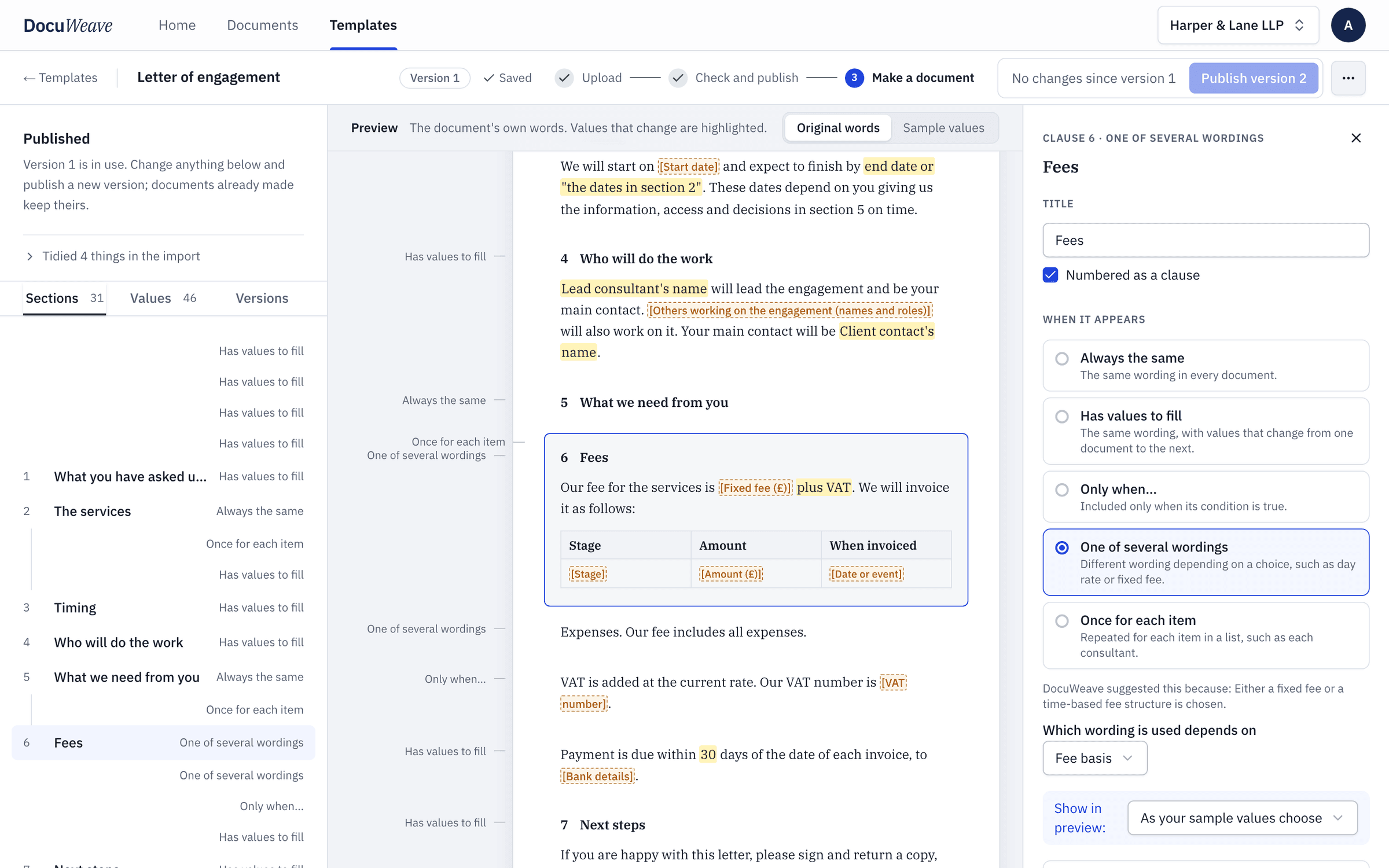
- One of several wordings
“Charge a fixed fee in stages, or charge for time at set rates.”
The fee quote was a fixed £14,500 plus VAT in three stages, so the fixed-fee wording and invoice table were used.
- Once for each item
“One paragraph for each service, one bullet for each thing the client must provide, and one row for each invoice stage.”
The scoping notes listed three services and three client requirements, and the quote three invoice stages.
- One of several wordings
“License the deliverables to the client, or assign them outright.”
The notes said the client keeps the deliverables outright, so the assignment wording was used.
- The AI decides from the paperwork
“Include the VAT line and the non-solicitation term only where they apply.”
The quote gave a VAT number and the notes agreed six months' non-solicitation, so both were included.
One worked example, start to finish
The letter of engagement in DocuWeave, from upload to approval.
 1
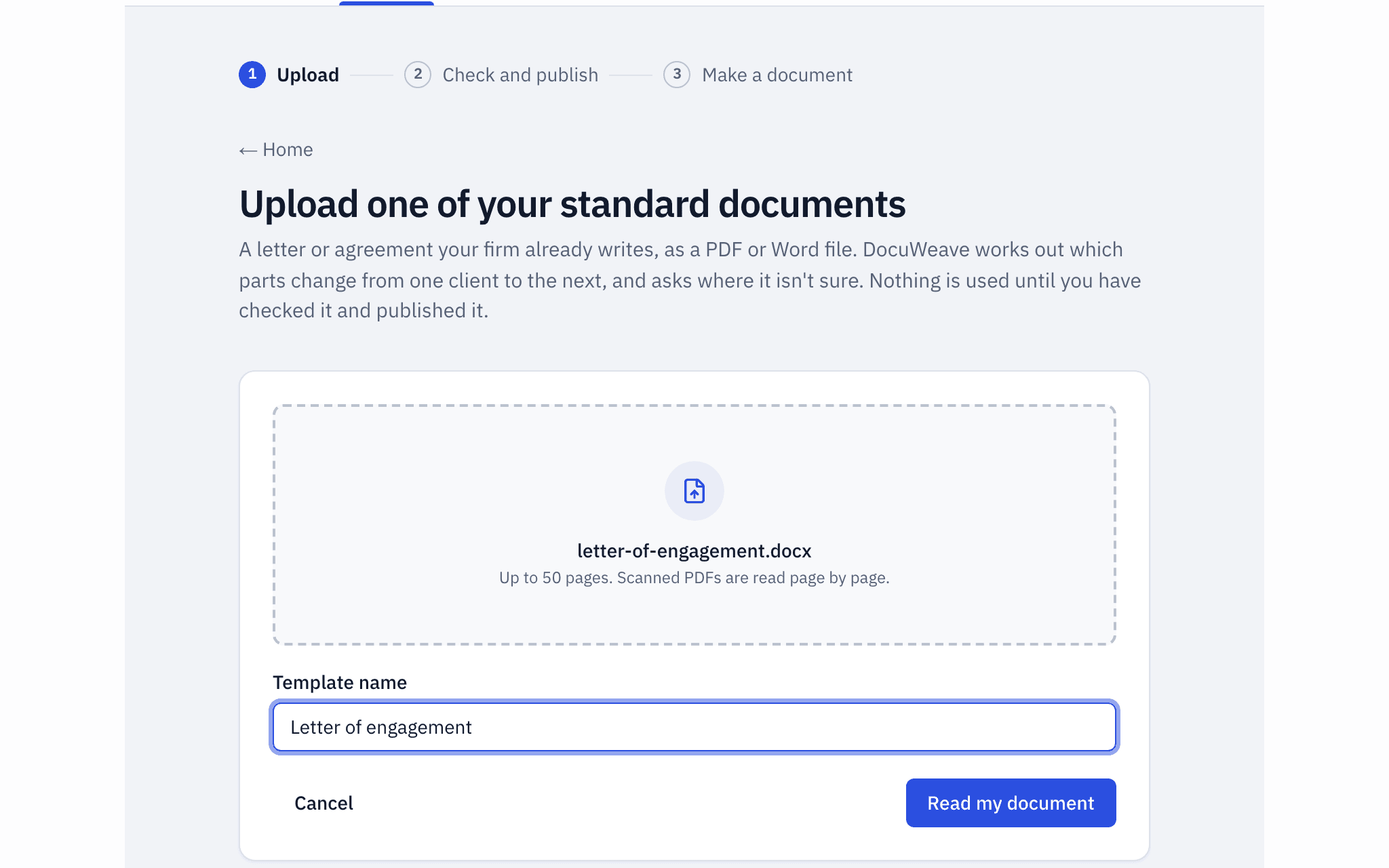
The document uploaded
The letter of engagement, a Word file, uploaded as it is.
- 2
The template it became
It found 28 sections and 42 values, and asked 14 questions before publishing. Fees are a choice: fixed fee or time-based.
 3
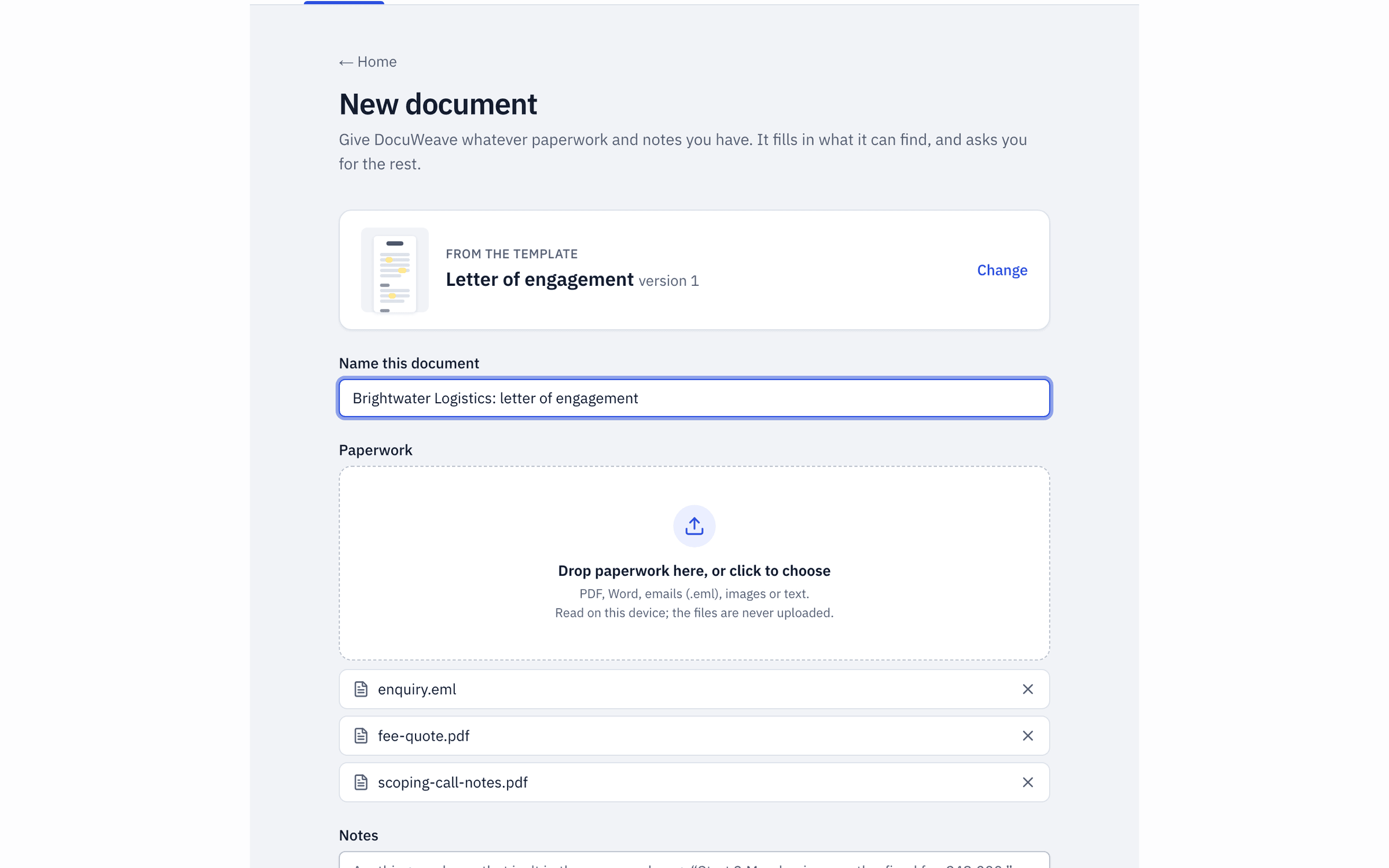
The paperwork dropped in
The client's enquiry email, the scoping call notes and the fee quote.
 4
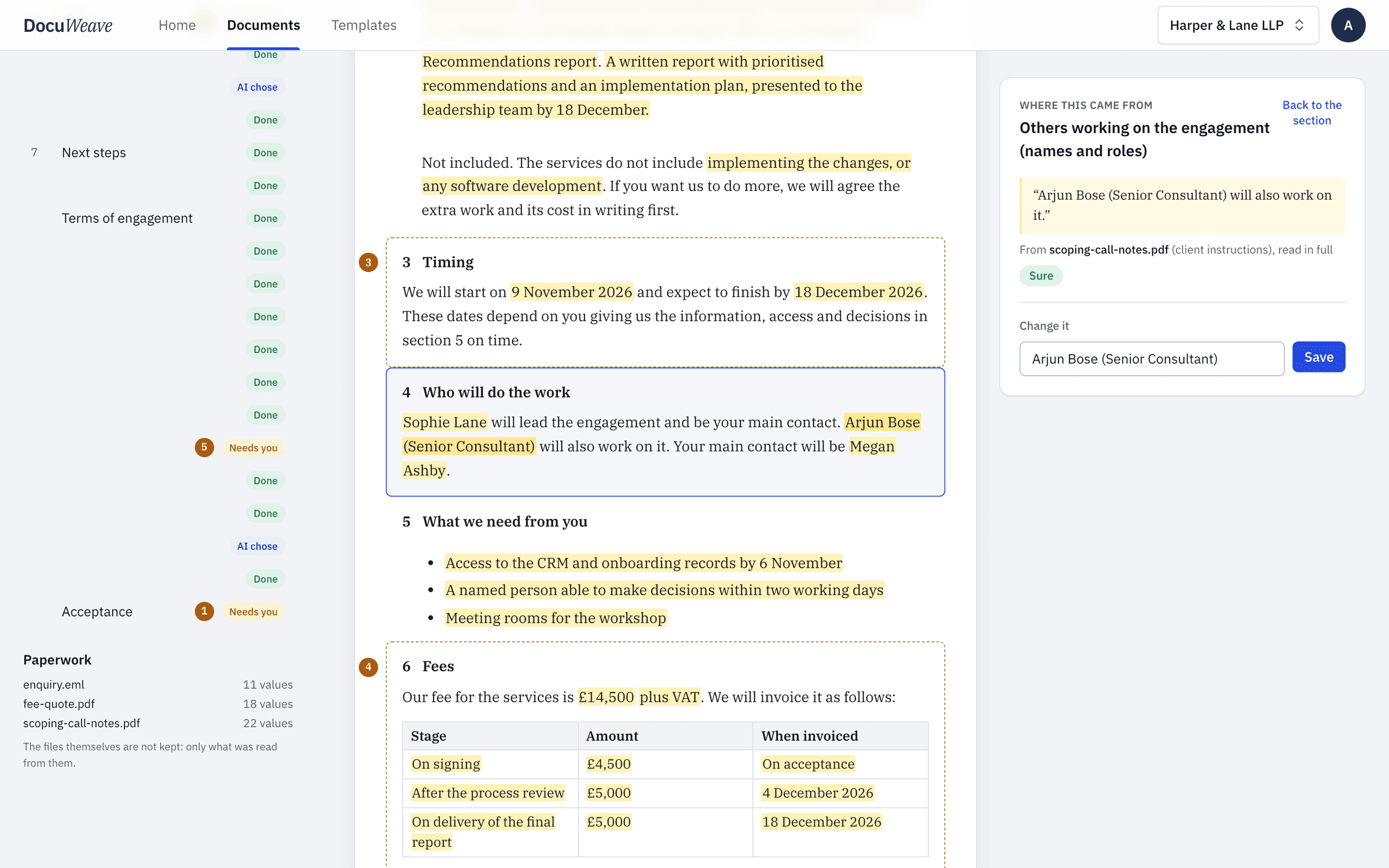
What was found, with sources
35 of 45 values filled from the paperwork, each with the passage it came from.
 5
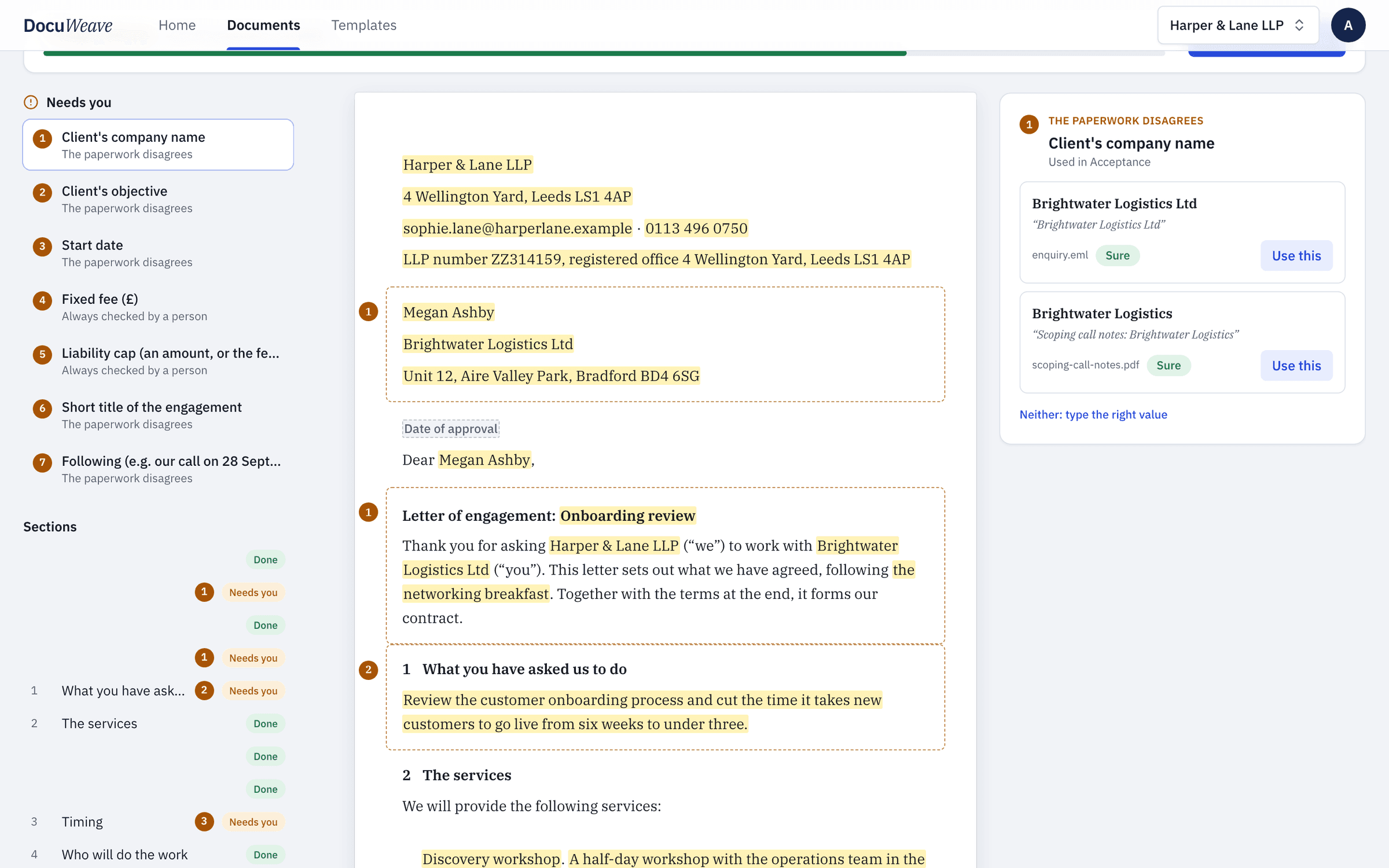
What it asked
7 things for a person, starting with the client's company name, and the fee and liability cap to confirm.
 6
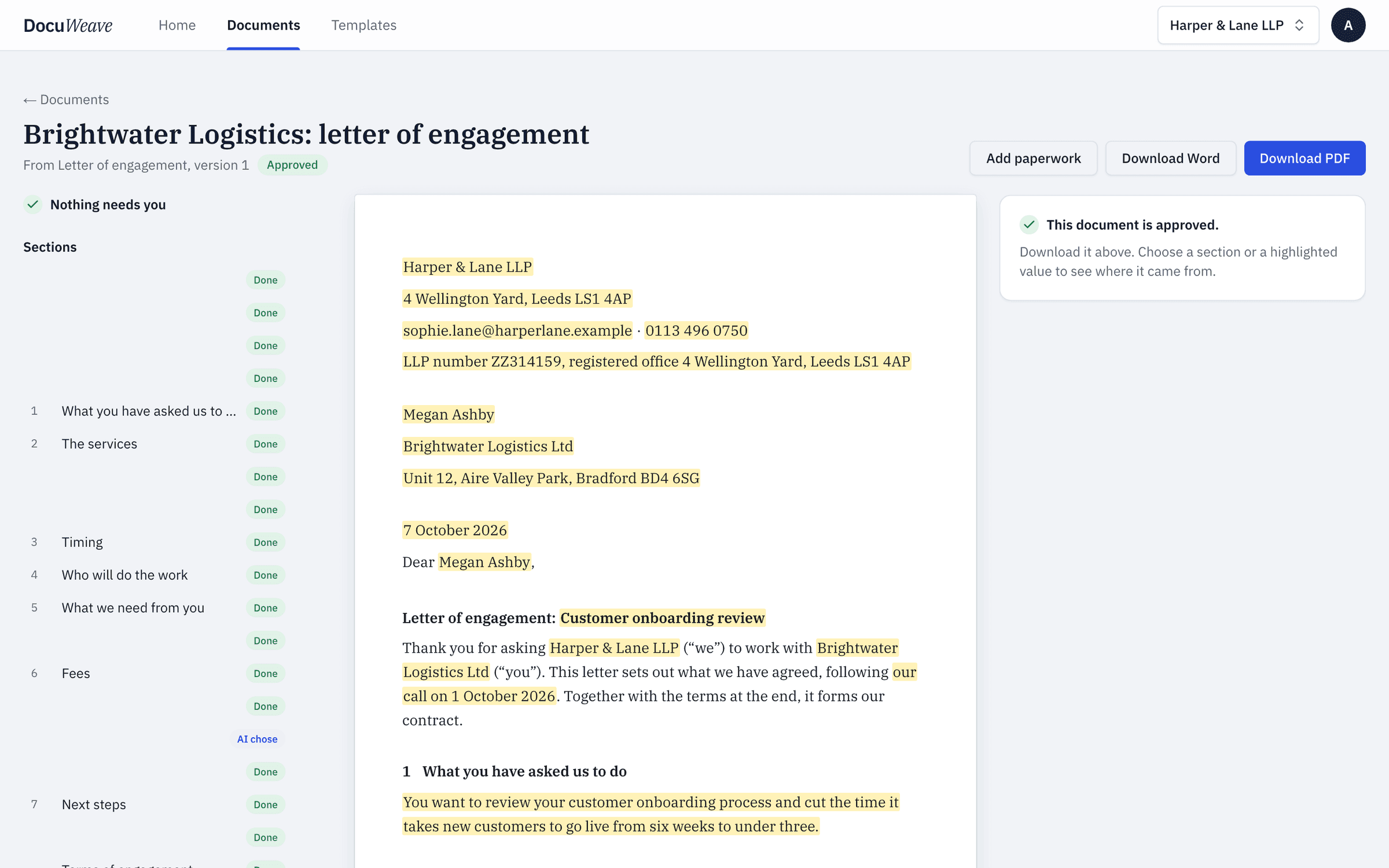
The approved output
Approved, with Word and PDF downloads.
A free letter of engagement to download
- Letter of engagement, filled with fictional details (Word)
- Letter of engagement, filled with fictional details (PDF)
Use it as it is, or upload it to DocuWeave and make it a template.
DocuWeave is not a law firm. A general template for common situations in England and Wales. It is not tailored to you and we do not update it when the law changes, so check it suits your situation before you use it. Terms.
Made by DocuWeave. Use at your own discretion.
Questions people ask
What is a letter of engagement?
A letter that confirms the work a firm will do for a client, the fee and the terms. Once the client accepts it, the letter and its terms form the contract.
What should a letter of engagement include?
The client's objective, the services and what is not included, the dates, who will do the work, what the client must provide, the fees and how they are invoiced, and the terms.
Fixed fee or time-based?
This letter supports both. A fixed fee is invoiced in agreed stages; a time-based fee is charged at set rates with an estimate.
Who owns the work produced?
The letter offers two options: the client may use the deliverables under a licence, or the firm assigns the intellectual property to the client on payment.
How does the client accept it?
By signing and returning a copy, or by replying by email to confirm acceptance.
Use this template
It opens in DocuWeave as a template you can check, change and publish. Nothing is used until you do.