Loan agreement template
A loan agreement sets out the terms on which a lender lends money to a company or LLP: the amount, the purpose, interest, how and when it is repaid, and what happens on default. It also covers early repayment, the borrower's promises, any security or guarantee, and a repayment schedule. Solicitors and lenders prepare one for each loan, with the parties, the amount, the rate and the schedule changing each time.
Made by DocuWeave. Use at your own discretion.
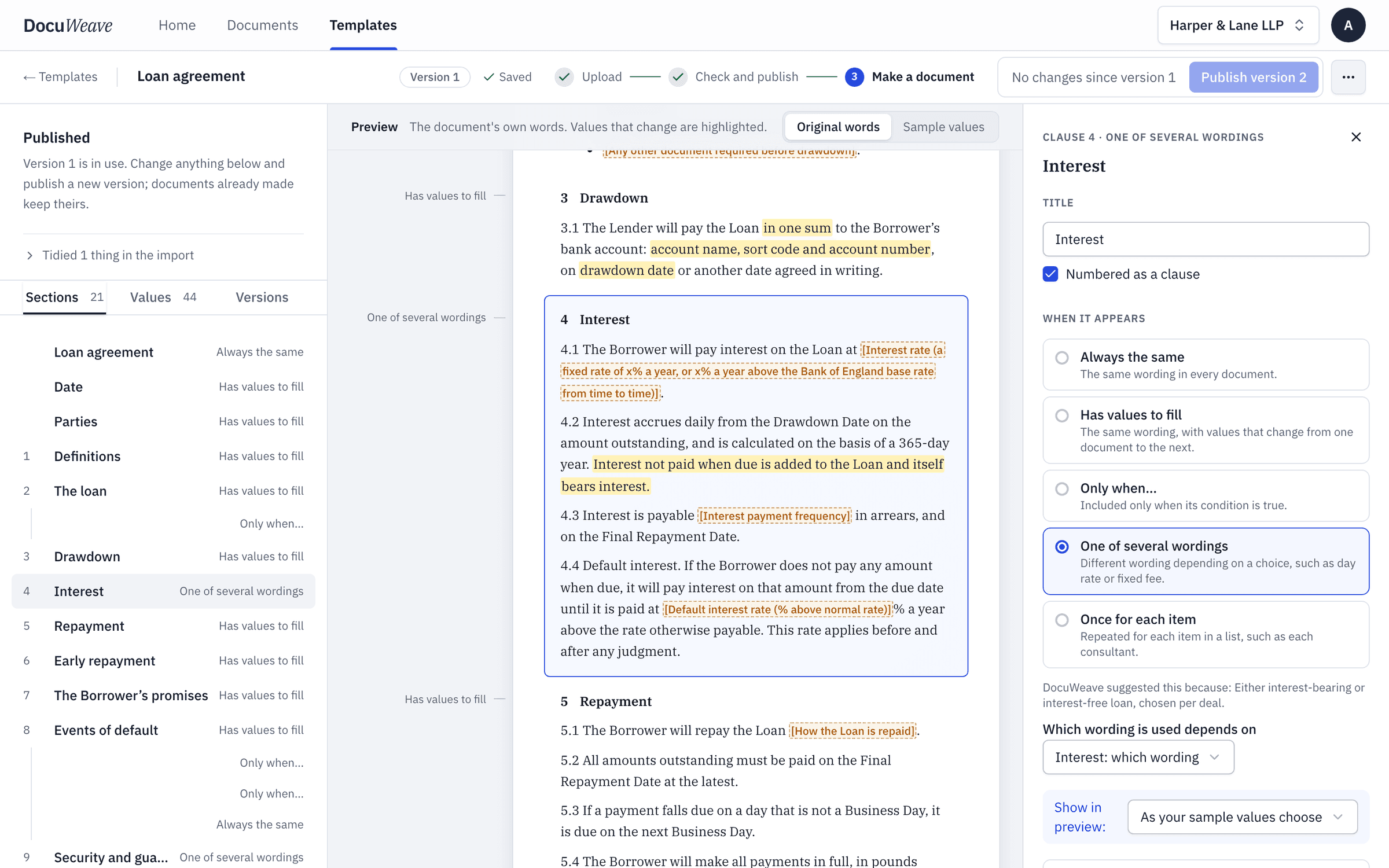
What changes each time
20 values. Everything else is your wording, kept exactly.
The parties
- Lender
- Borrower company and registered number
- Registered office
- Who signs for each party
The loan
- Amount
- Purpose
- Drawdown date and method
- Conditions before payment
- Bank accounts for drawdown and repayment
Interest and repayment
- Interest-bearing or interest-free
- Interest rate
- Default interest uplift
- Repayment method and final date
- Repayment schedule
- Early repayment notice and fee
Protection
- Accounts the Borrower sends
- Cure periods
- Cross-default threshold
- Security and guarantee
- Costs
The rules it usually needs
Written in plain English when the template is set up.
- One of several wordings
“Use the interest-bearing wording, or the interest-free wording, each with its own default interest.”
The loan carried a fixed 7% a year, so the interest-bearing clause was used, with 3% default interest on top.
- Once for each item
“One row in the repayment schedule for each instalment.”
The schedule had four half-yearly instalments, so the table has four rows and a total.
- One of several wordings
“Say what secures the loan, or that it is unsecured.”
A debenture and a personal guarantee were agreed, so the secured wording and the Companies House registration clause were used.
- The AI decides from the paperwork
“Include the conditions before payment, the change of control and cross-default events, and the note that schedule interest is estimated, only where the paperwork calls for them.”
The approval email listed conditions, change of control and cross-default, so those were included; the rate was fixed, so the estimate note was left out.
One worked example, start to finish
The loan agreement in DocuWeave, from upload to approval.
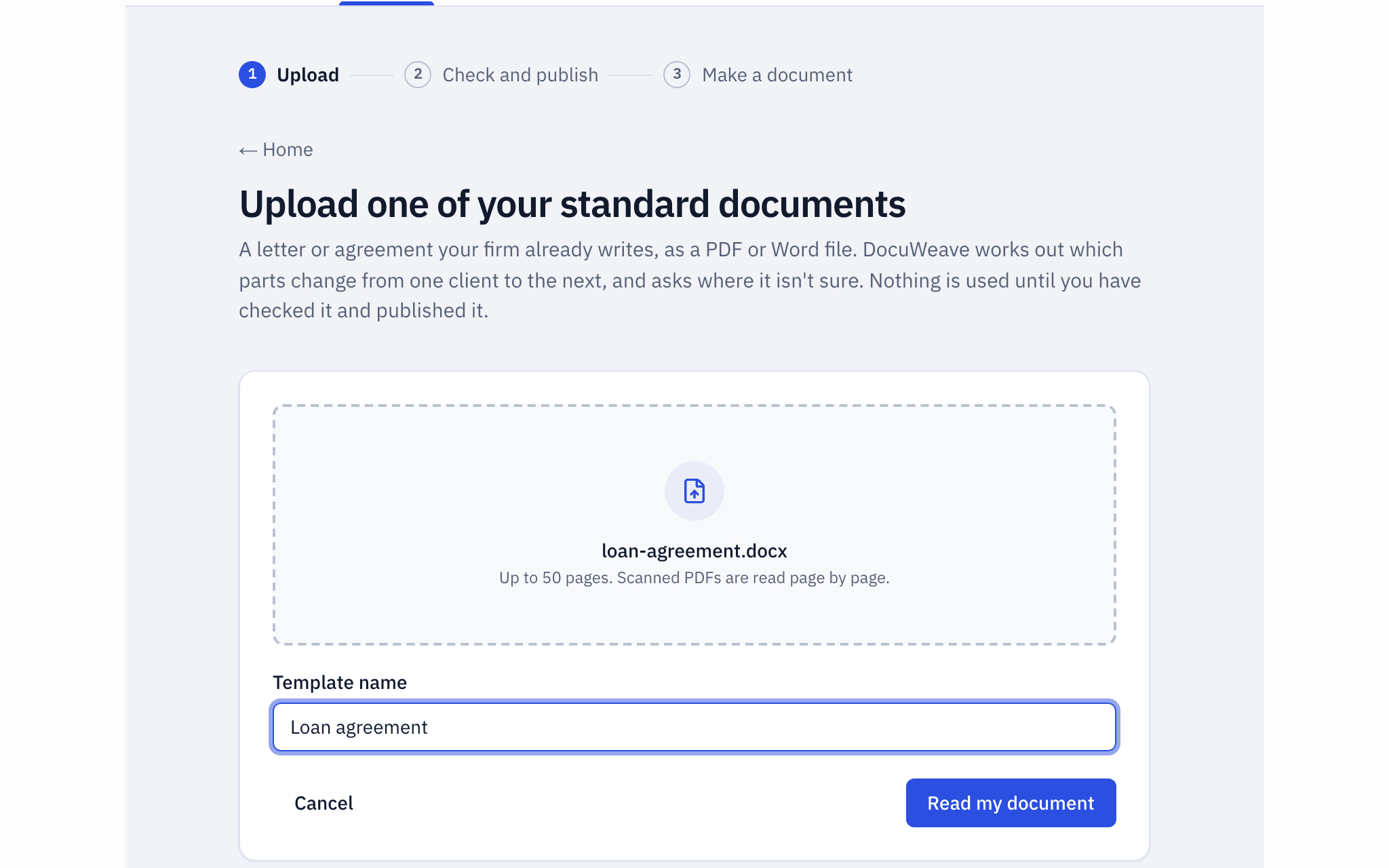 1
The document uploaded
The loan agreement, a Word file, uploaded as it is.
- 2
The template it became
It found 22 sections and 48 values, and asked 16 questions before publishing. Interest is a choice: interest-bearing or interest-free.
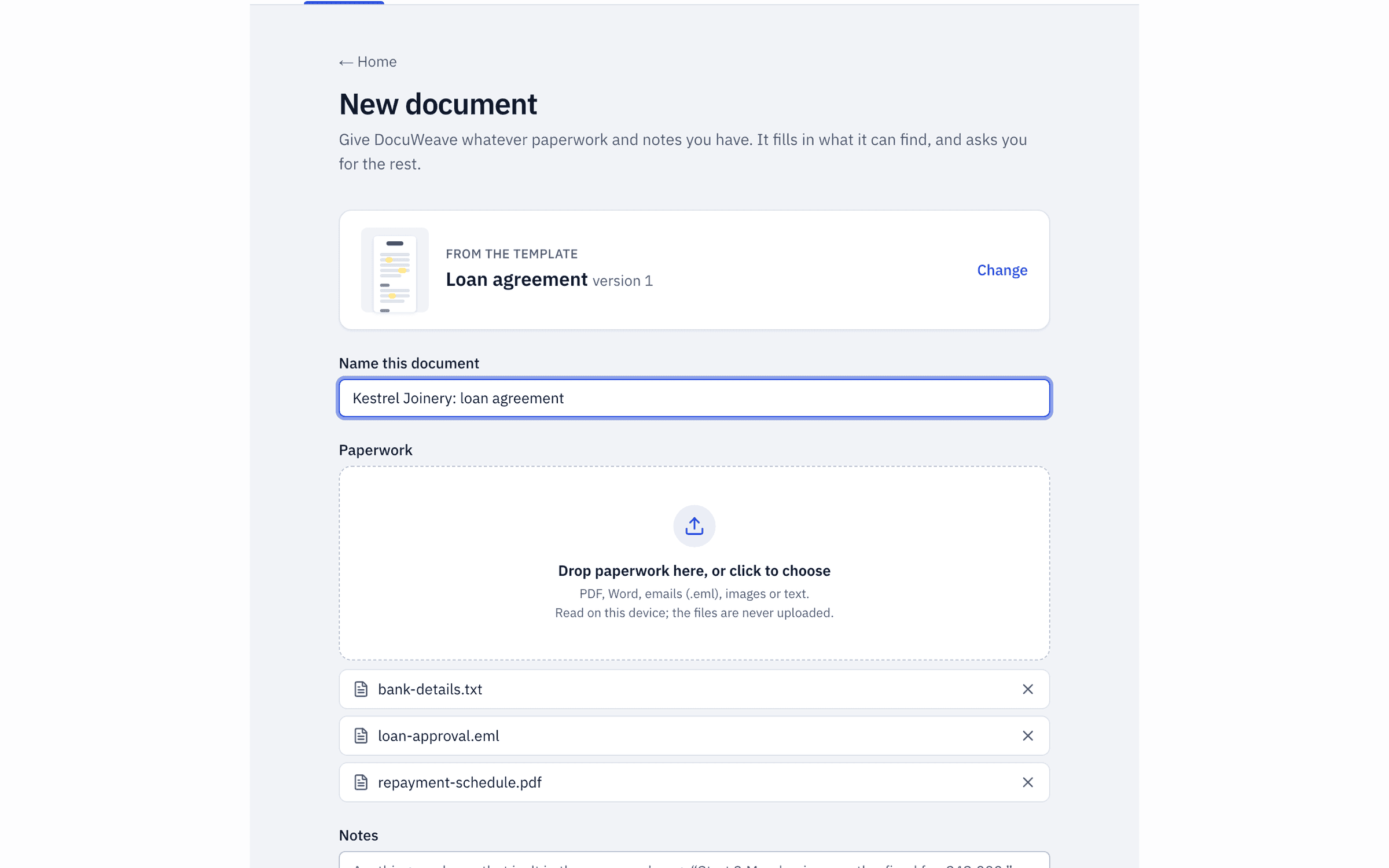 3
The paperwork dropped in
The lender's loan approval email, the repayment schedule and the bank details.
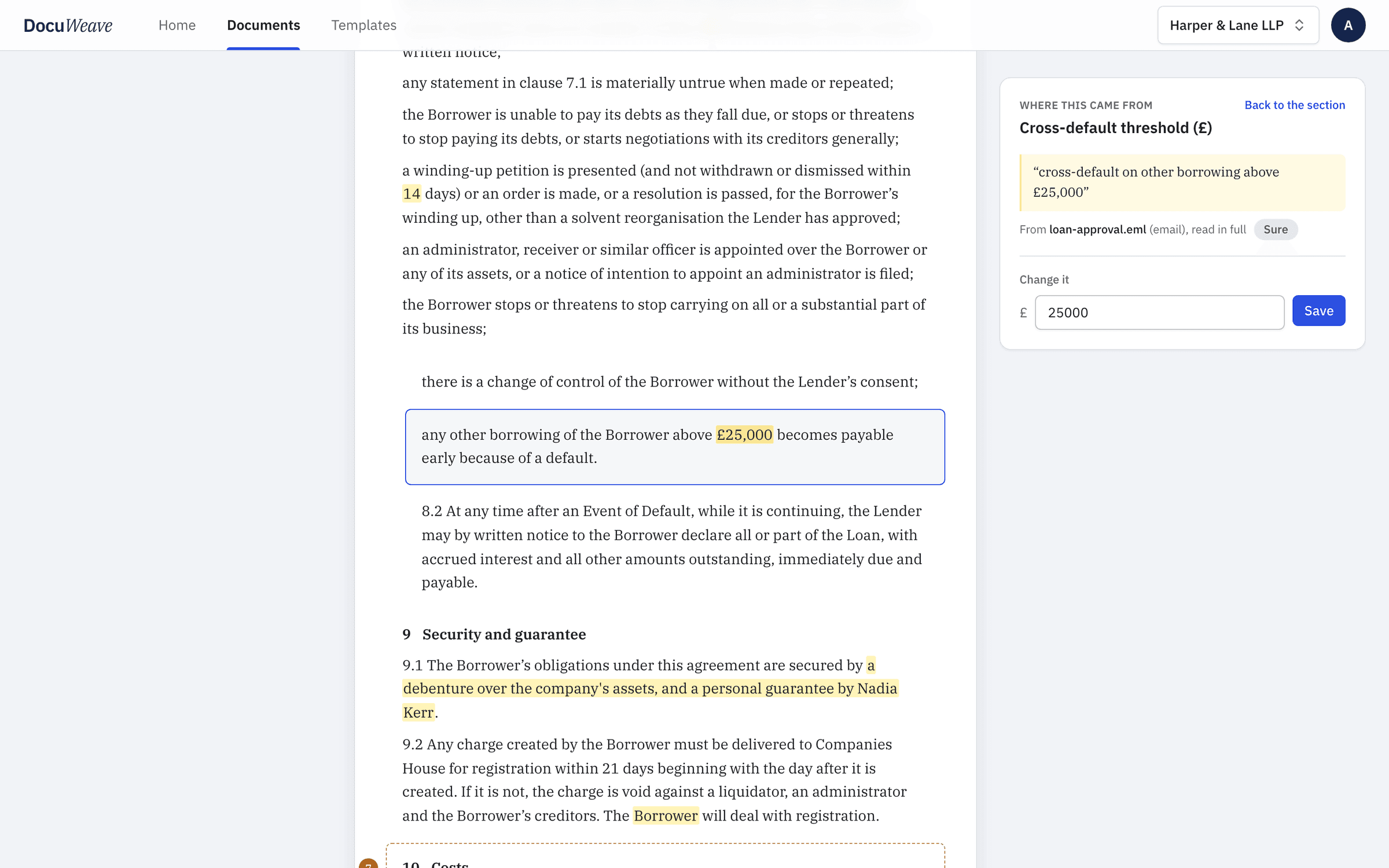 4
What was found, with sources
41 of 43 values filled from the paperwork, each with the passage it came from.
 5
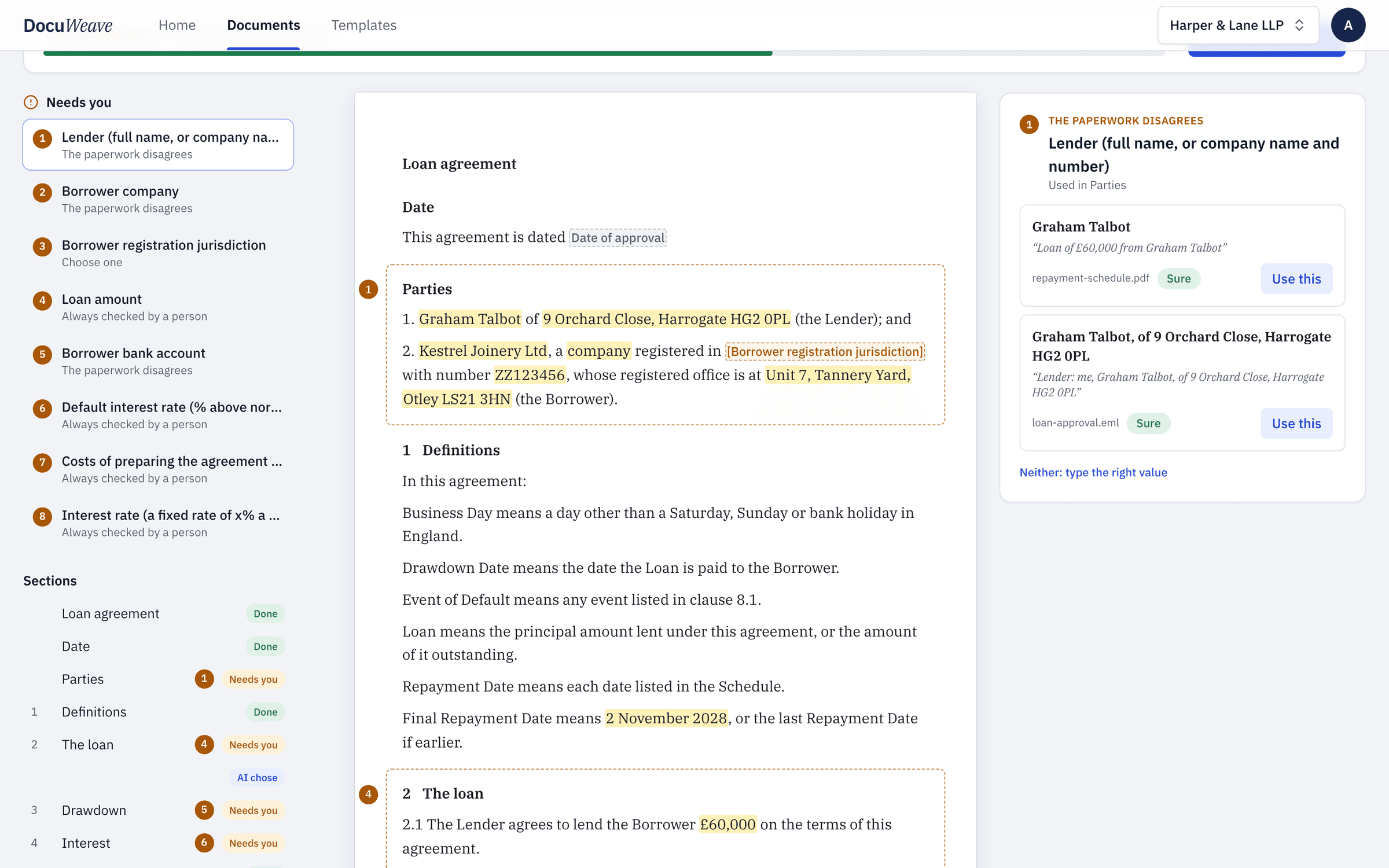
What it asked
8 things for a person, starting with the lender's name, and the amount and rates to confirm.
 6
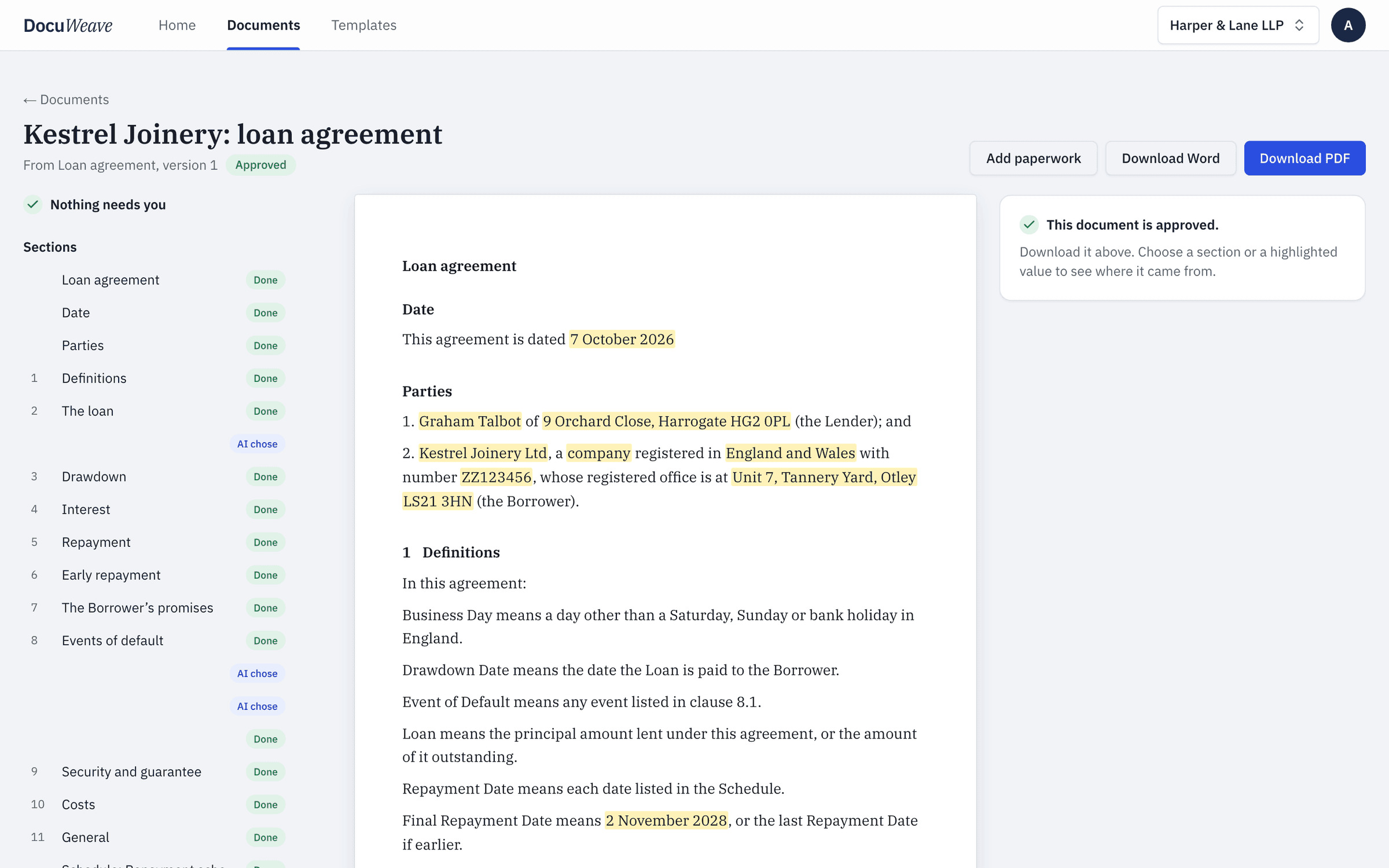
The approved output
Approved, with Word and PDF downloads.
A free loan agreement to download
- Loan agreement, filled with fictional details (Word)
- Loan agreement, filled with fictional details (PDF)
Use it as it is, or upload it to DocuWeave and make it a template.
DocuWeave is not a law firm. A general template for common situations in England and Wales. It is not tailored to you and we do not update it when the law changes, so check it suits your situation before you use it. Terms.
Made by DocuWeave. Use at your own discretion.
Questions people ask
Can this loan agreement be used for a loan to an individual?
No. It is for a loan to a company or LLP, or another loan that is not regulated under the Consumer Credit Act 1974. Loans to individuals, sole traders and small partnerships can be regulated and need different paperwork.
Does a secured loan need registering?
A charge created by a company must be delivered to Companies House within 21 days, beginning with the day after it is created. If it is not, it is void against a liquidator, an administrator and the company's creditors.
Can the borrower repay early?
Yes, under this agreement, on the notice it sets out and with any fee the parties agree. Amounts repaid early cannot be borrowed again.
What is default interest?
Extra interest on any amount not paid when due, at the uplift the parties agree. The uplift should be a genuine protection of the lender's interest, not a penalty.
Does a loan agreement need to be a deed?
No. A loan agreement is usually signed as a simple contract, because the lender gives value by lending. Security and guarantees may be granted separately.
Use this template
It opens in DocuWeave as a template you can check, change and publish. Nothing is used until you do.