Statement of work template
A statement of work sets out exactly what a supplier will deliver for a client on one project: the background, the scope, what is out of scope, the deliverables with their dates, and who signs them off. It sits under a main contract, so a new one is written for every project while the contract stays the same.
Adapted from Cabinet Office (13 February 2025). Contains public sector information licensed under the Open Government Licence v3.0.
What changes each time
13 values. Everything else is your wording, kept exactly.
The parties
- Buyer
- Supplier
- Contract reference
The work
- Background
- Scope
- Out of scope
- Start date
- Social value priorities
Deliverables
- Deliverable, due date and sign-off, one row each
- Who signs off deliverables
- Days to review a deliverable
Contacts
- Buyer contact
- Supplier contact
The rules it usually needs
Written in plain English when the template is set up.
- Once for each item
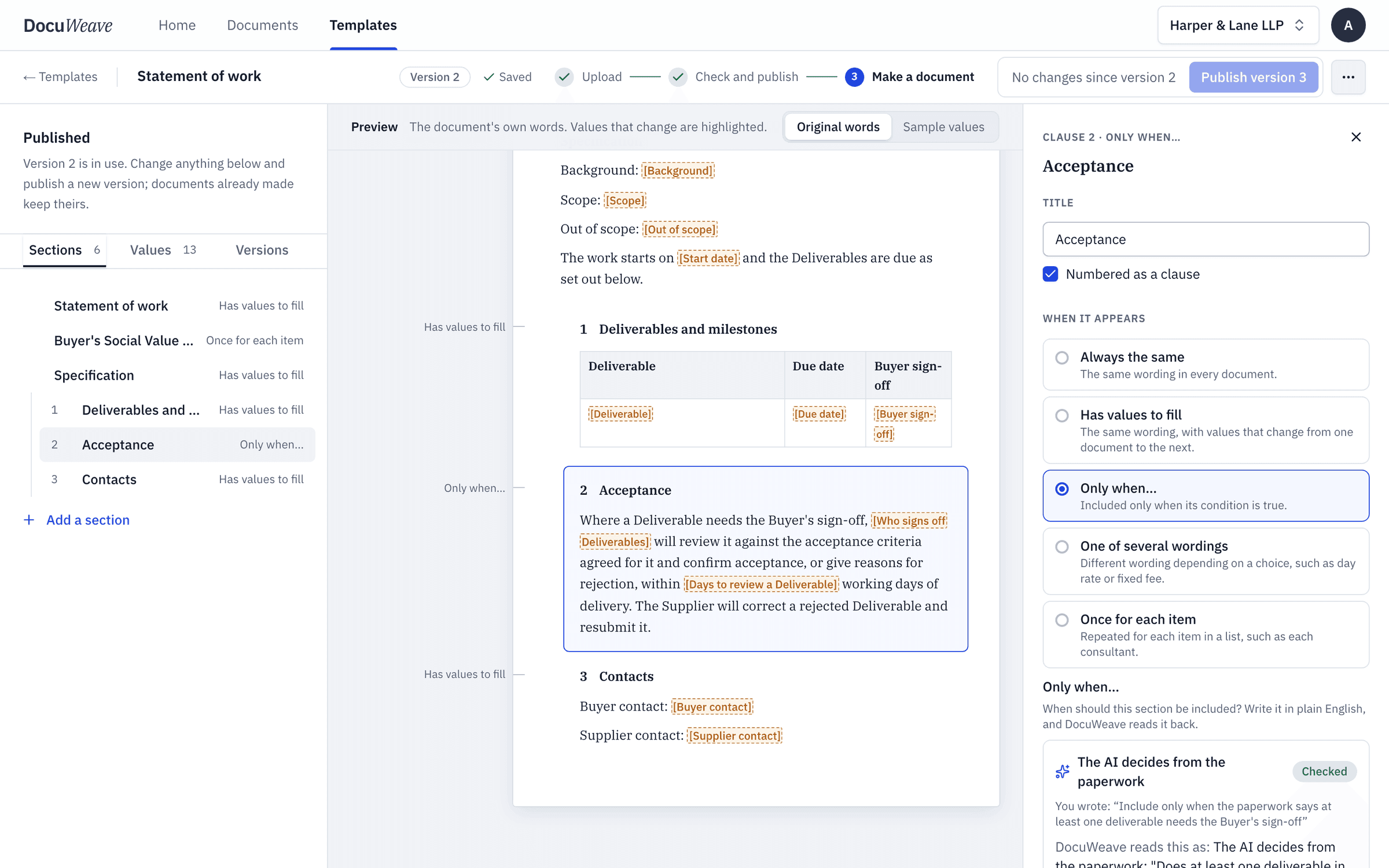
“A table row for each deliverable, with its due date and whether the buyer signs it off.”
Four deliverables in the agreed proposal, four rows in the table.
- Once for each item
“A line for each of the buyer's social value priorities.”
The brief named two priorities, so two lines appear.
- The AI decides from the paperwork
“Include the acceptance clause only when the paperwork says at least one deliverable needs the buyer's sign-off.”
Three of the four deliverables needed sign-off, so the acceptance clause was included, with that reason shown.
One worked example, start to finish
The statement of work in DocuWeave, from upload to approval.
 1
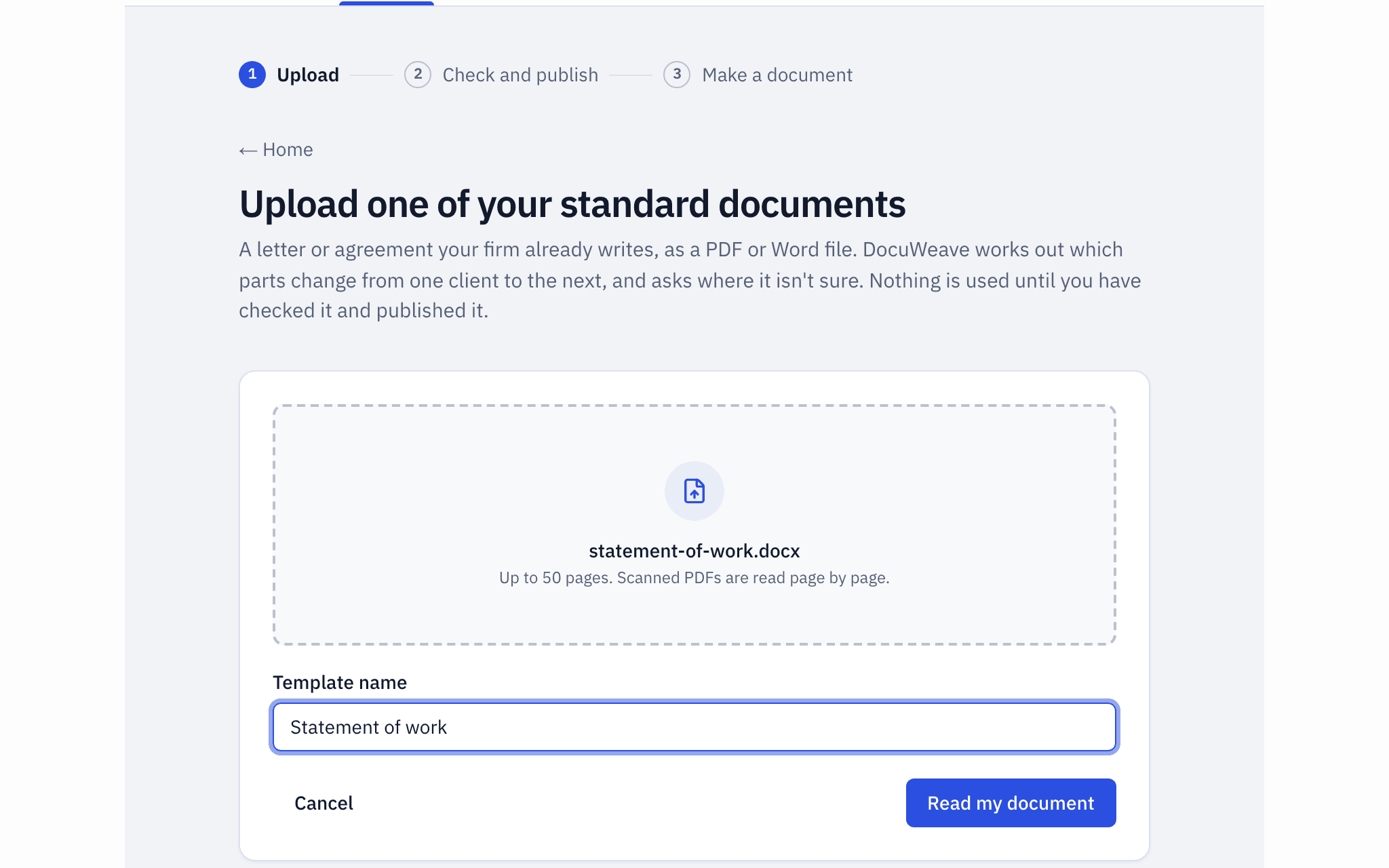
The document uploaded
The Cabinet Office Mid-Tier Schedule 2 (Specification), a Word file, uploaded as it is.
- 2
The template it became
It found 3 sections and 4 values, and asked 2 questions. The template then gained a deliverables table, one row per deliverable.
 3
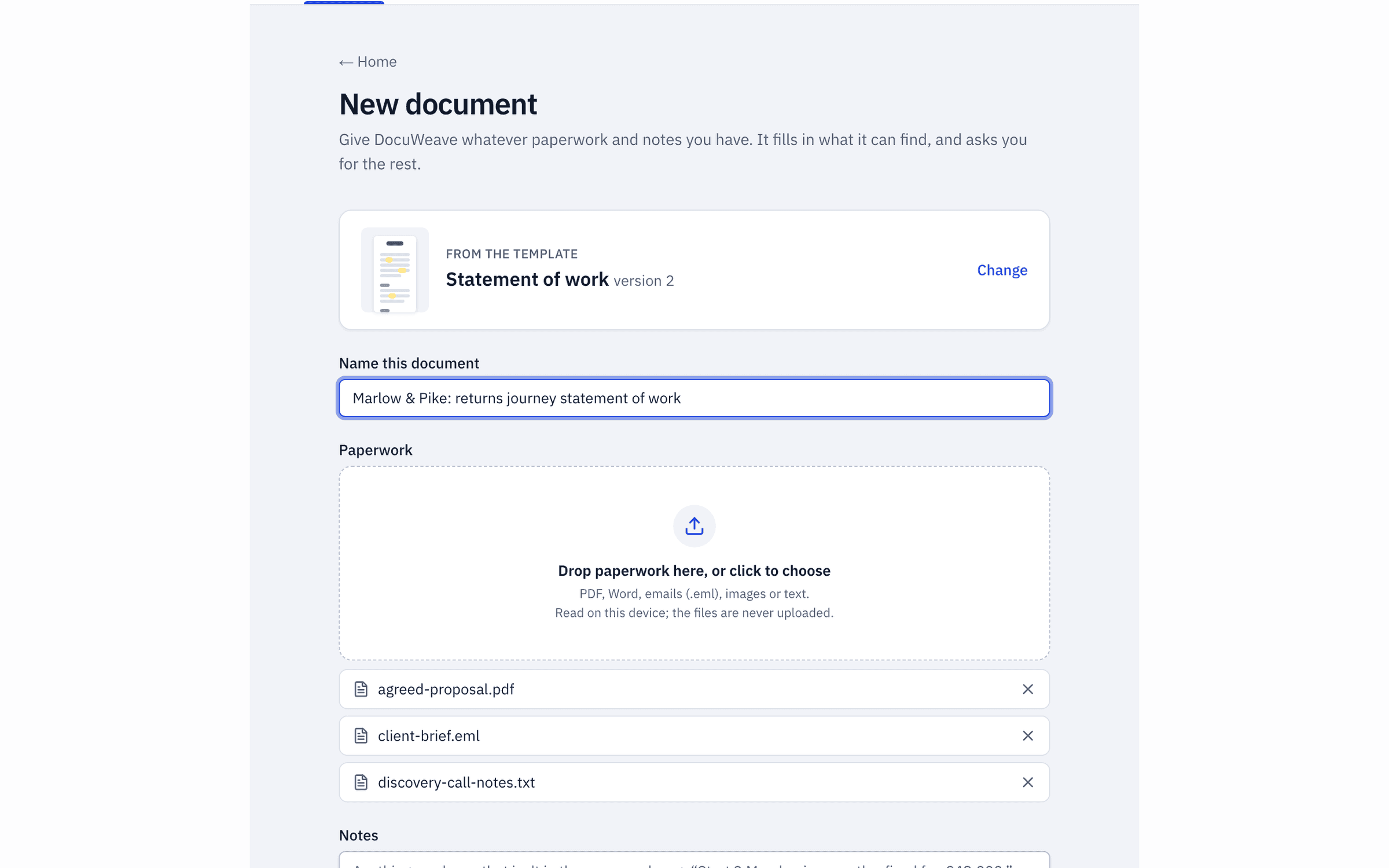
The paperwork dropped in
The client's brief, the discovery call notes and the agreed proposal with its timetable.
 4
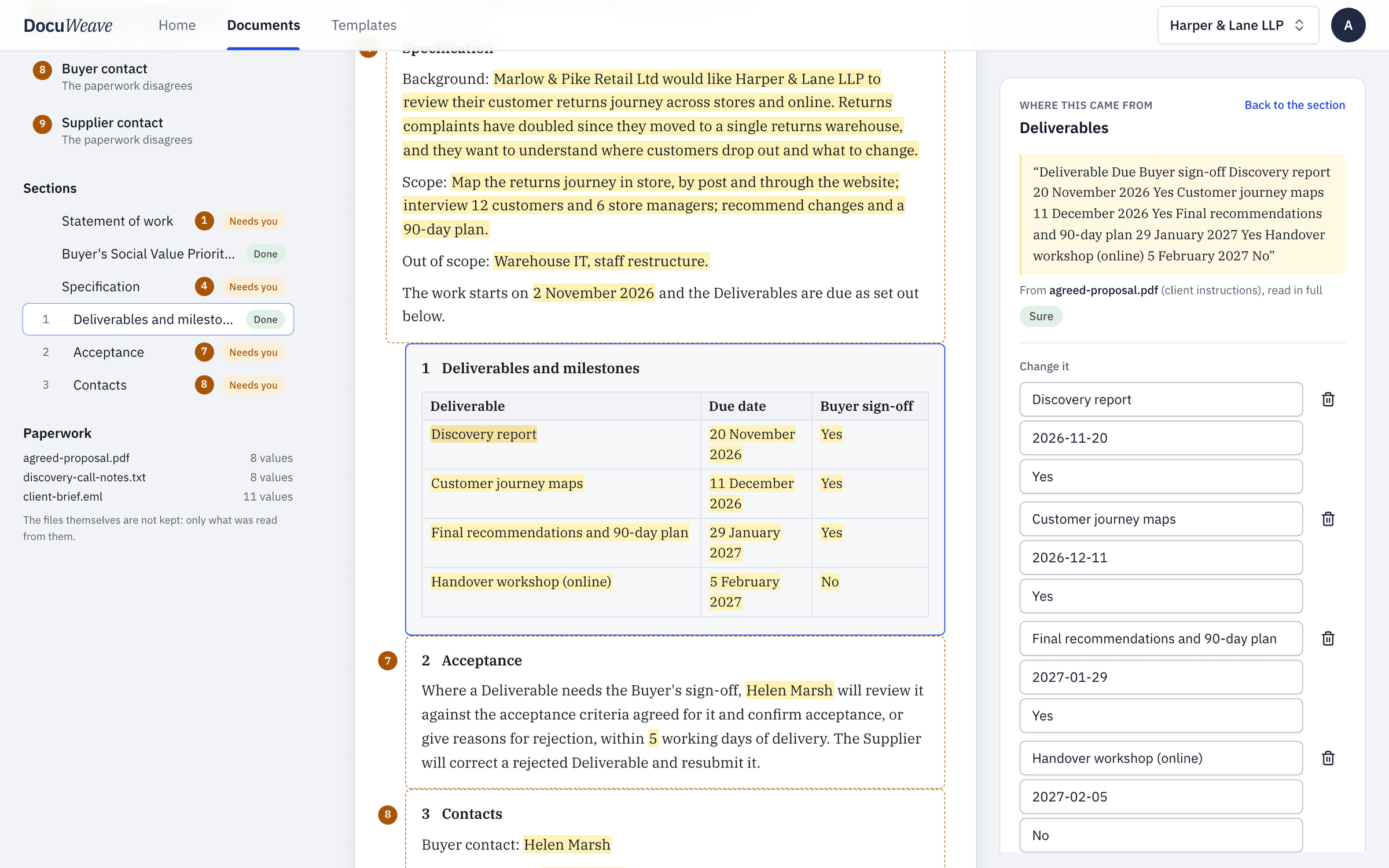
What was found, with sources
13 of 13 values read from the paperwork, each with the passage it came from, the deliverables table included.
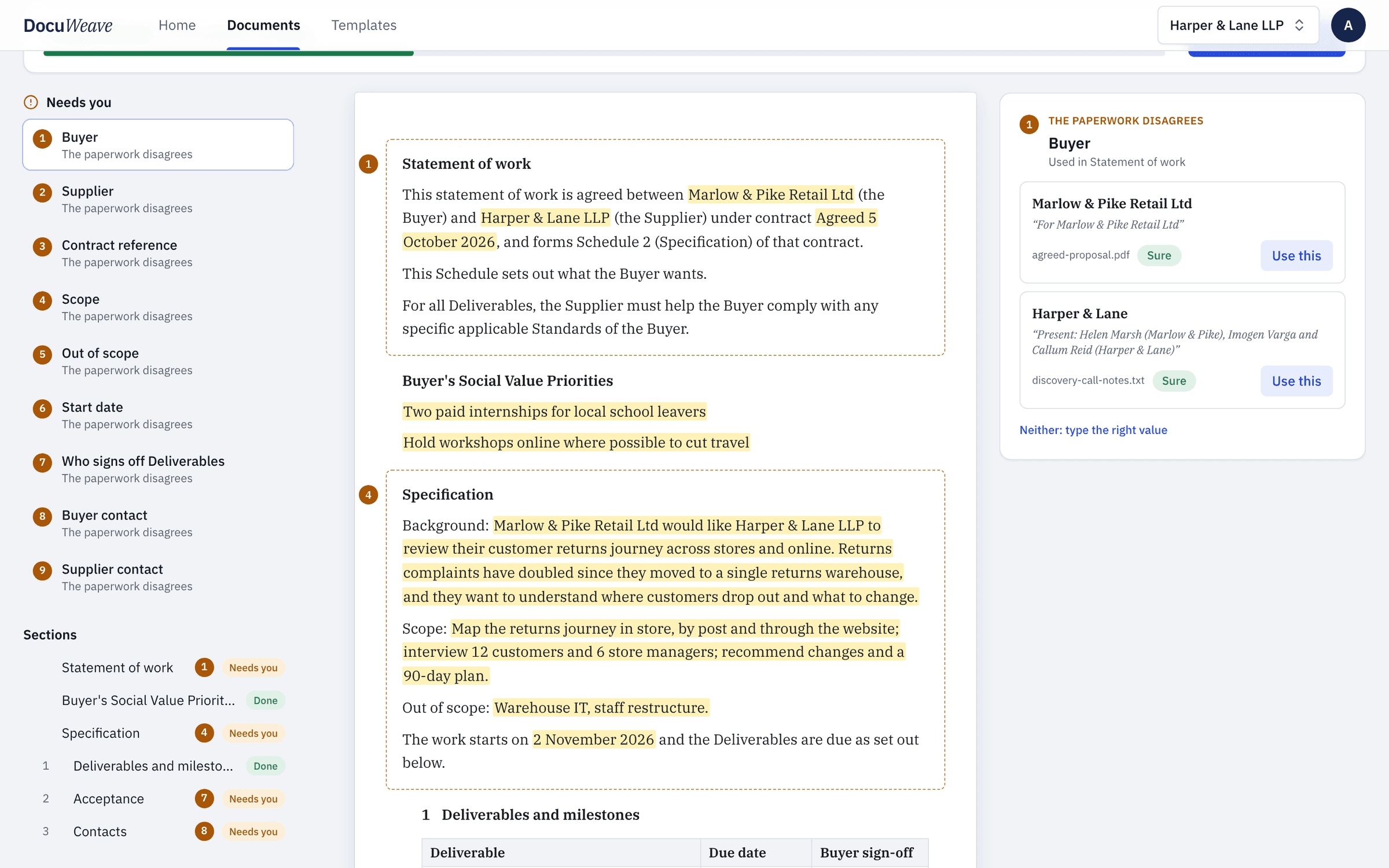 5
What it asked
9 things for a person, each where the brief, the call notes and the proposal put it differently.
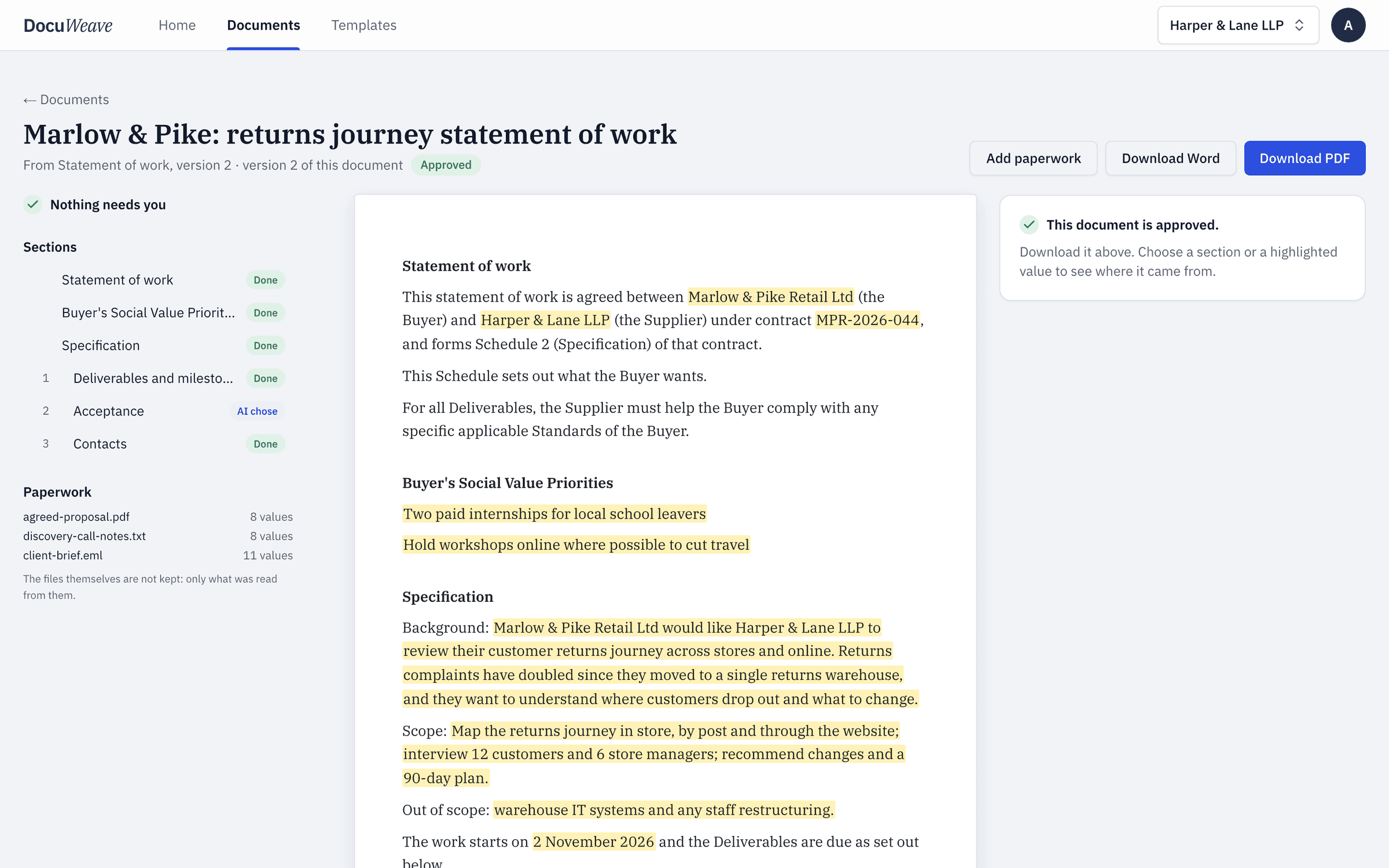 6
The approved output
Approved, with Word and PDF downloads.
A free statement of work to download
- Statement of work, filled with fictional details (Word)
- Statement of work, filled with fictional details (PDF)
Use it as it is, or upload it to DocuWeave and make it a template.
DocuWeave is not a law firm. A general template for common situations in England and Wales. It is not tailored to you and we do not update it when the law changes, so check it suits your situation before you use it. Terms.
Adapted from Cabinet Office (13 February 2025). Contains public sector information licensed under the Open Government Licence v3.0.
Questions people ask
What is the difference between a statement of work and a contract?
The contract sets the legal terms for the whole relationship. A statement of work sits under it and describes one project: what will be delivered, by when, and how it will be accepted.
What should a statement of work include?
Usually the background and objectives, what is in and out of scope, each deliverable with its date, how deliverables are accepted, and the named contacts on each side.
Why list what is out of scope?
Saying what the project does not cover avoids later disagreement about whether extra work is included, and gives a clear basis for a change request.
Who signs off the deliverables?
Whoever the client names in the statement of work. This template includes an acceptance clause only when at least one deliverable needs the client's sign-off.
Can I use my own statement of work instead?
Yes. Upload your own Word or PDF version and DocuWeave turns it into a template in your wording, with a row per deliverable filled from your proposal.
Use this template
It opens in DocuWeave as a template you can check, change and publish. Nothing is used until you do.